
Best AI for Travel Planning in 2026: 5 Tools Compared
We ran the same Lisbon trip through five AI tools — Sigma, Layla, Wanderlog, ChatGPT and Gemini — to compare itineraries, budgets, research and logistics.

AI can plan a trip in two very different ways. Dedicated travel planners focus on itineraries, routes and recommendations. General AI assistants and AI browsers give you more flexibility for research, comparisons and trips with detailed constraints.
We tested five tools with the same Lisbon trip to see how they handled the itinerary, budget, logistics and recommendations. The differences were bigger than we expected. Some produced a ready-made plan in seconds while others were better at explaining trade-offs or researching current travel details.
How We Tested the AI Travel Planning Tools
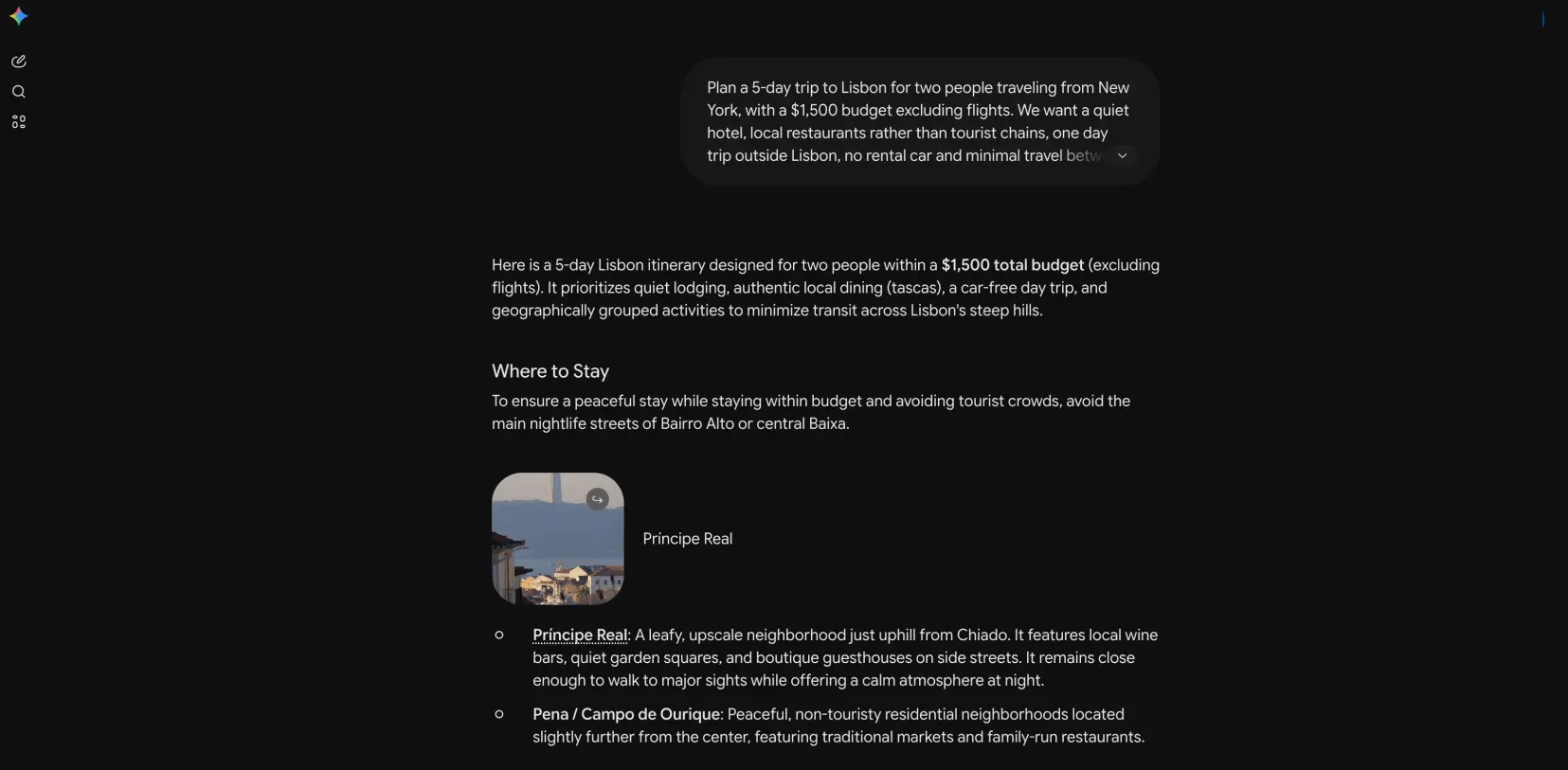
We used the free version of each tool and gave all five the same planning request:
We compared how each tool handled the same constraints rather than scoring their marketing claims. We looked at itinerary quality, personalization, travel research, current information, routes and logistics, budget handling, booking support and how much work remained before the plan was usable.
Prices and availability change constantly, so we also checked whether each tool clearly separated planning estimates from information that should be verified before booking.
Best AI Tools for Travel Planning: Quick Comparison
Before diving into the details, here’s a quick look at how the best AI trip planners compare:
Sigma Browser: Best for Planning Trips Across Multiple Websites
What it does:
Sigma is a full AI browser, not a separate travel planning app. Research and planning happen in the same place: open hotel and attraction pages, analyze reviews, compare options side by side, and hand all of that context to the AI without exporting anything into a different tool.
In practice, a trip like this one can move through something like research destinations → compare hotels → analyze pages and reviews → research neighborhoods → build an itinerary → refine the plan with AI, all inside the same browser session.
How it performed in our test:
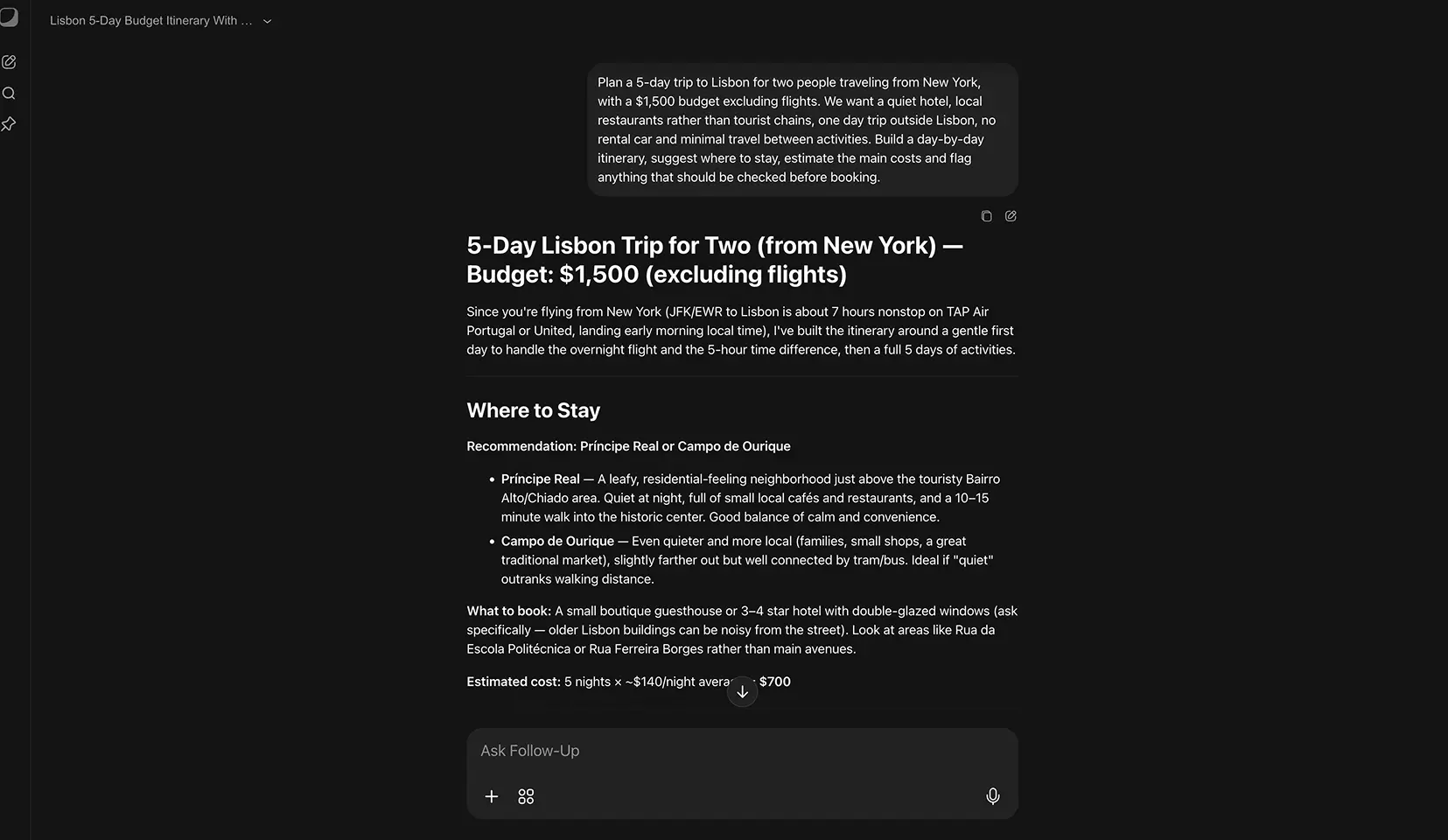
Sigma put together a five-day itinerary centered on Príncipe Real or Campo de Ourique, grouped activities geographically, kept the first day light, and used public transport for the Sintra day trip.
Budget is where Sigma pulled ahead: the estimate came in around $970–$1,165, leaving a $335–$530 cushion inside the $1,500 limit.
The answer also showed some practical judgment beyond the itinerary itself. It suggested limiting Sintra to one or two major sights, checking room noise before booking, and confirming current transport schedules rather than assuming they would stay fixed.
Where it was lighter on detail was in naming exact places. Sigma pointed to types of accommodation and local tascas rather than specific properties, so following through means opening those pages yourself, which is really the point of a browser-first approach.
Best for:
Doing your own research: comparing hotel pages, reading reviews, checking neighborhoods, and having AI turn it all into an organized plan.
Main limitation:
Sigma does not replace a dedicated booking platform. Prices, availability, and final travel details still need to be checked on the relevant websites.
Layla: Best for Ready-to-Use Travel Recommendations
What it does:
Layla approaches the task more like a dedicated travel planner than a research tool. Instead of spending much of the answer on process, it turns the request into a destination plan with accommodation, food, and daily activities right away.
How it performed in our test:
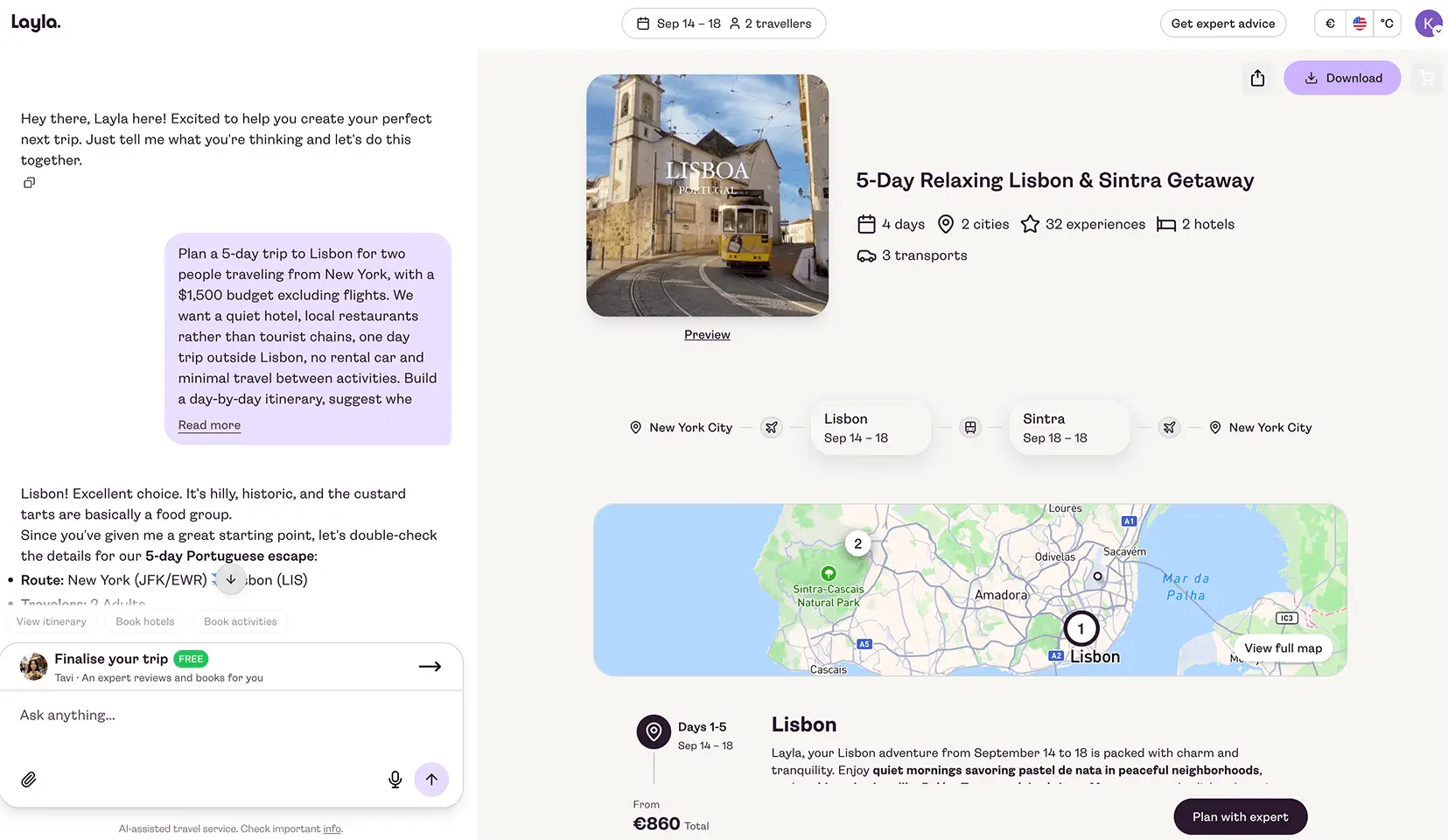
Layla immediately selected Chalet D’Ávila Guest House as the accommodation and built a compact itinerary around Alfama, Belém, Sintra, and Príncipe Real.
It also caught a detail that could easily affect the trip: the standard room at the recommended guesthouse had shared bathroom facilities. Layla flagged that before suggesting an upgrade or a different hotel.
The itinerary stayed within budget at about $1,355 and included specific recommendations such as Taberna da Rua das Flores.
The trade-off was depth. Layla gave less explanation for why certain routes minimized travel, and its budget breakdown was broader than the ones from Sigma, Wanderlog, and ChatGPT.
Best for:
Skipping the comparison shopping, since it gives you concrete picks right away: a specific hotel, a specific restaurant.
Main limitation:
Specific recommendations are useful, but availability, room details, and current prices still need confirmation before payment.
Wanderlog: Best for Itinerary and Trip Logistics
What it does:
Wanderlog leans into the organizing side of a trip: day-by-day planning combined with routes, attractions, transportation, and budget tracking in one place.
How it performed in our test:
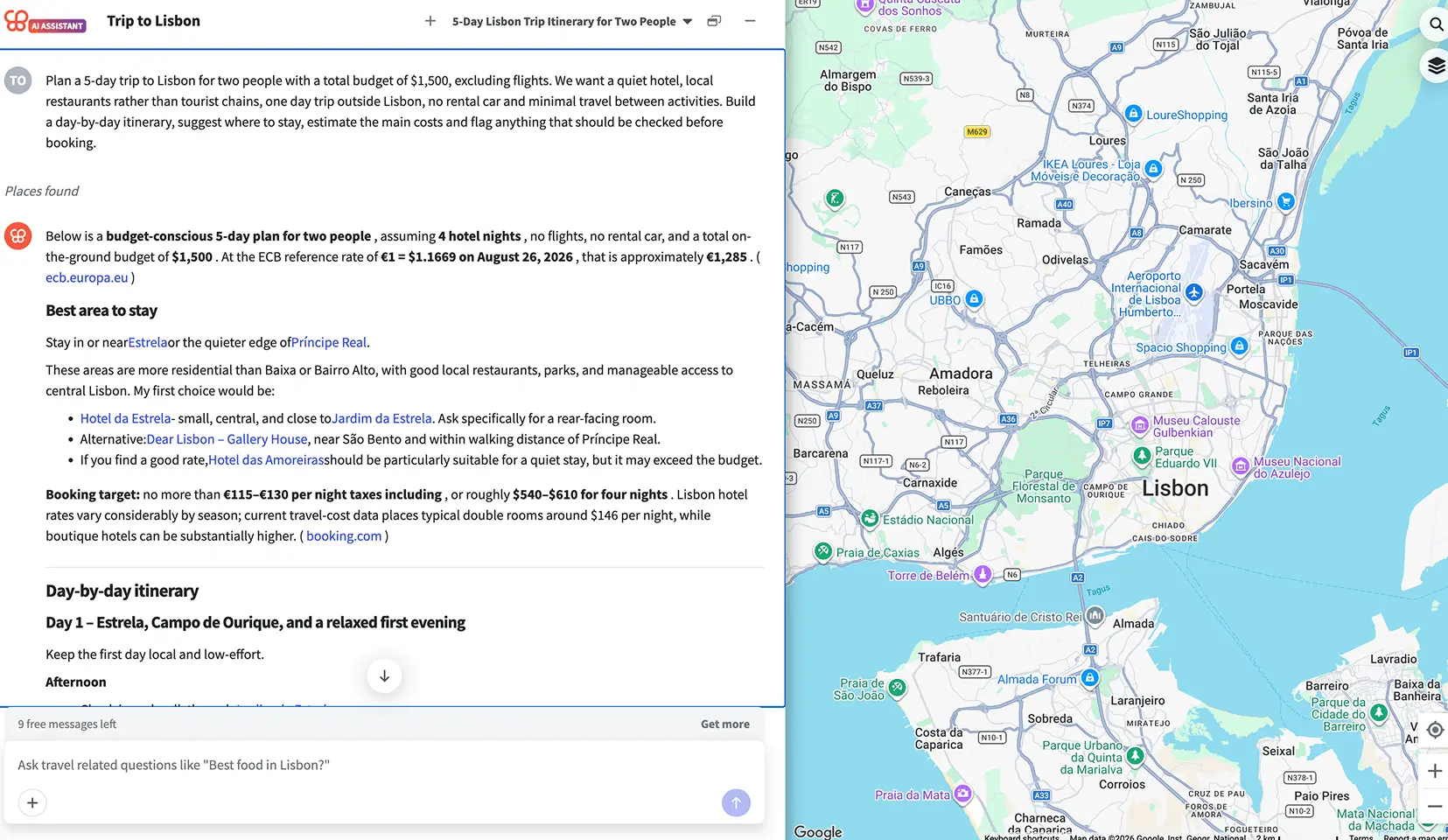
Wanderlog produced one of the most detailed itineraries in the test. It suggested several quiet areas and hotels, grouped central Lisbon by location, and kept Sintra as a dedicated day trip.
What set it apart was how current the research felt. The answer included source links for attraction prices, public transport, and Sintra access, and it even flagged that a combined Train and Bus ticket was temporarily suspended, worth checking before the trip. It also gave specific restaurants and practical guidance for timed entry at Pena Palace.
Budget control was the weaker spot. The first estimate ranged from $1,355 to $1,640, so the high end went over the $1,500 limit. Wanderlog then built a tighter version at around $1,500 by lowering the hotel target and trimming food and attraction spending.
Best for:
Trips where logistics matter as much as sightseeing: tight connections, timed tickets, transport that actually needs planning.
Main limitation:
The tool provided good budget detail but did not stay safely below the requested ceiling on its first calculation.
ChatGPT: Best for Flexible Budget-Conscious Planning
What it does:
ChatGPT works as a general assistant rather than a dedicated travel app. You give it detailed constraints, then adjust individual parts of the trip and keep refining through conversation.
How it performed in our test:
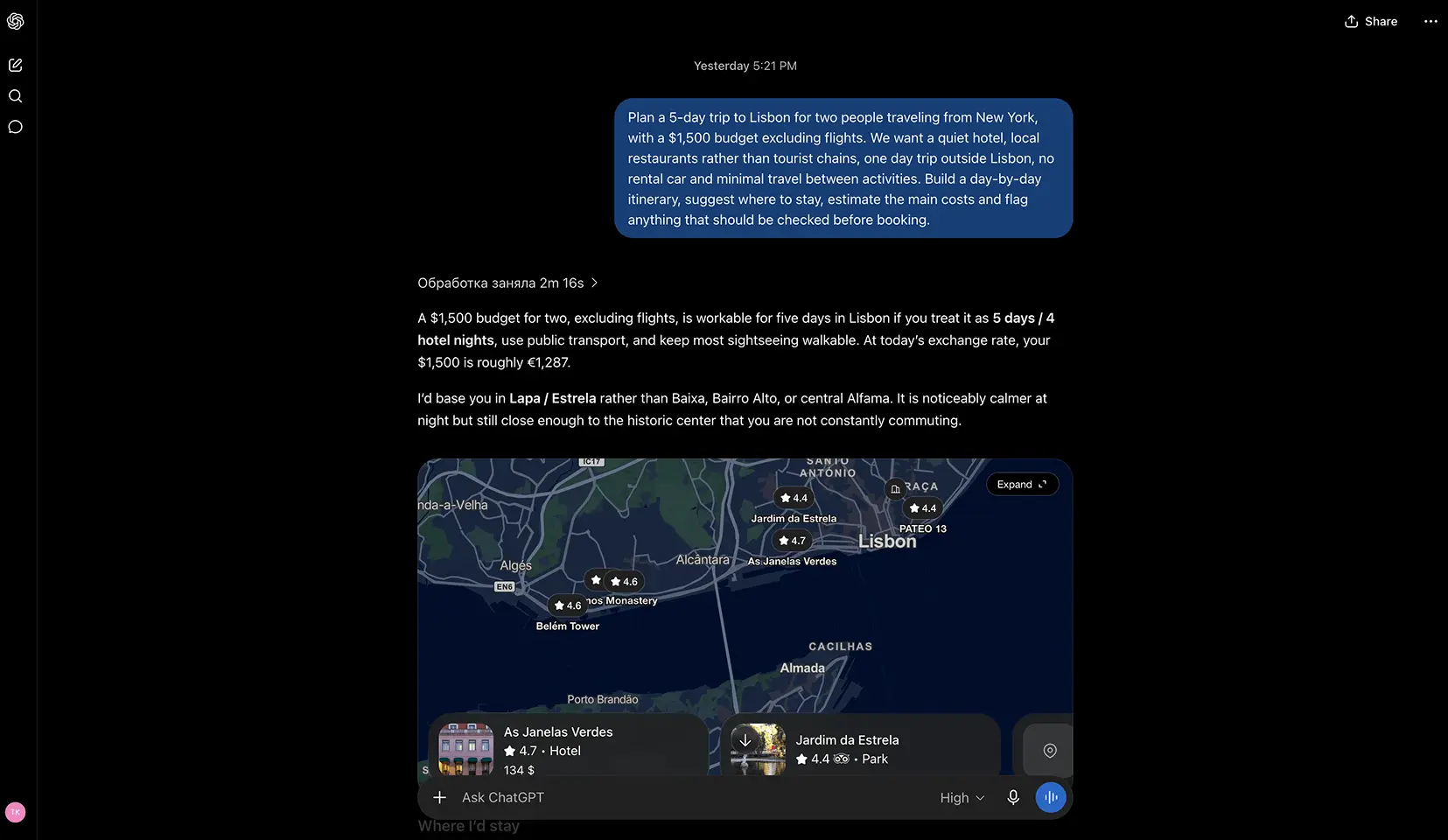
ChatGPT built the trip around eastern Alfama and kept the itinerary geographically compact. Baixa and Chiado became one walking loop, Belém got its own day, and Sintra stayed the only major trip outside Lisbon.
ChatGPT priced the trip at roughly $1,101–$1,406, comfortably under the $1,500 ceiling rather than spent right up to it, and that same discipline ran through the rest of the breakdown: accommodation, tourist tax, food, local transport, Sintra, and attractions were all broken out separately.
The practical details held up too, like asking for an interior-facing hotel room, checking air conditioning, and leaving time to walk the Pena Palace grounds rather than treating it as a quick photo stop.
It did not provide booking links or verified hotel availability, and it was upfront that the prices were planning estimates to check before payment.
Best for:
A tighter budget and a plan you expect to rework more than once. Its conversational format makes edits painless.
Main limitation:
The free response gave useful current estimates but less verifiable real-time research than Wanderlog produced in our test.
Gemini: Best for Quick, Simple Trip Planning
What it does:
Gemini turns a natural language request into a complete itinerary without needing a dedicated travel planning interface.
How it performed in our test:
Gemini created a clean five-day structure covering central Lisbon, Alfama, Belém, and a day outside the city. It grouped activities reasonably well and included practical reminders for Pena Palace, Lisbon’s hills, and early luggage drop-off after the flight from New York.
The plan required more decisions from the traveler than the other results. For Day 3, for example, Gemini offered Sintra or Cascais instead of picking one based on the stated requirements. Hotel recommendations also stayed at the neighborhood level rather than naming a specific property.
Its budget section estimated the trip at around $1,400–$1,500, but the upper ends of the individual category ranges can add up to more than the stated $1,500 limit, so the final number needs another manual check.
Best for:
A fast first draft. Good starting point, but expect to make some of the final calls yourself.
Main limitation:
The result was less specific than the other tools and left several choices unresolved.
What Is the Best AI for Travel Planning?
The right tool mostly comes down to how much of the process you want to hand over.
If you’d rather stay in control of the research yourself, comparing hotel listings, reading reviews, checking neighborhoods, and let AI organize what you find, Sigma Browser fits that workflow directly. It keeps research and planning in the same place, and the itinerary it builds reflects pages you’ve actually looked at rather than a recommendation from nowhere.
If you’d rather get a finished plan with specific picks right away, Layla gets there fastest. Wanderlog is the stronger choice when transport, timed tickets, and other logistics matter as much as the sightseeing itself. ChatGPT and Gemini sit in between, useful for a flexible starting point or a quick first draft, though both leave more verification work for later.
None of the five removes the need to double check prices, availability, and current schedules before booking. The real difference is how much of that groundwork each tool does upfront, and how much it leaves for you.
How to Use AI to Plan a Trip
Most of the gap between a good AI itinerary and a mediocre one comes down to what you put into the prompt, not which tool you pick.
- Be specific about constraints, not just the destination. "Plan a trip to Lisbon" gives the AI almost nothing to work with. Budget, traveler count, pace, and dealbreakers, no rental car, no tourist-trap restaurants, are what actually shape a usable plan, and every tool in our test performed better once those details were in the prompt.
- Treat the first answer as a draft, not a decision. All five tools produced a reasonable starting itinerary from one prompt, and all five needed follow-up. Ask for changes directly: swap a day, tighten the budget, ask why it picked one neighborhood over another.
- Use it to generate options, not to book anything. An AI trip planner is good at organizing possibilities: neighborhoods to consider, an order to see things in, a rough budget split. It's not a booking platform, and its confidence isn't proof. Treat prices and availability as a claim to verify, not a fact to act on.
- Ask it what it doesn't know. A useful follow-up prompt is asking the tool to flag anything time-sensitive or estimated rather than confirmed. Wanderlog did this unprompted in our test by surfacing a suspended transport ticket; most tools will do it if you ask directly.
- Cross-check anything with a date attached. Opening hours, temporary closures, and transport schedules are the details most likely to be outdated in an AI-generated plan, since they change more often than restaurant recommendations or neighborhood geography.
More articles




Download Sigma Browser
Questions & Answers
reach out to us on X at @Sigma_Browser
Get Sigma on Android


