
9 Best Perplexity AI Alternatives in 2026 for Research and AI Search
Compare the best Perplexity AI alternatives for search, research, privacy, academic work, and AI-assisted browsing.

Perplexity AI is still one of the easiest tools for turning web search into quick, cited answers. You ask a question, it scans sources, gives you a readable summary, and lets you ask follow up questions without opening twenty tabs just to understand one topic. But in 2026, Perplexity is no longer the only serious option. The market around Perplexity AI alternatives has split into several directions: standalone AI answer engines, deep research tools, privacy-first search engines, academic research tools, large AI assistants with real-time web search, and browser-native AI research tools.
That means the best alternative is not always a direct Perplexity clone. Some tools answer questions in a separate search interface. Others solve the same research problem inside the browser, inside academic databases, inside private search, or inside a broader AI assistant workflow. So the better question is not “what is the best Perplexity clone?” It is: which tool actually fits the way you search, research, browse, and work with sources?
Why Users Look for Perplexity AI Alternatives
Perplexity AI became popular because it made search feel less broken. Traditional search engines give you a list of links. Perplexity AI gives you a short answer, source links, related questions, and a cleaner research path. For people doing market research, academic research, content planning, or everyday fact-checking, that was a real upgrade.
But users are also starting to look for alternatives to Perplexity AI for practical reasons. Some want better deep research. Some want stronger document analysis. Some need a tool that works directly inside their browser instead of sitting in a separate tab. Others care more about privacy, academic sources, citation quality, advanced AI models, or fewer limits on free and paid plans.
There is also a bigger shift happening around AI search. Perplexity is no longer competing only with Google Search or other AI powered search engines. It now competes with ChatGPT Search, Google Gemini, Claude, Brave Search, You.com, academic research tools, AI browser tools, and browser-native agent research systems.
That is why this list is not just “nine tools that can search the web.” It is a practical breakdown of the best Perplexity AI alternatives in 2026, based on what each one is actually good at.
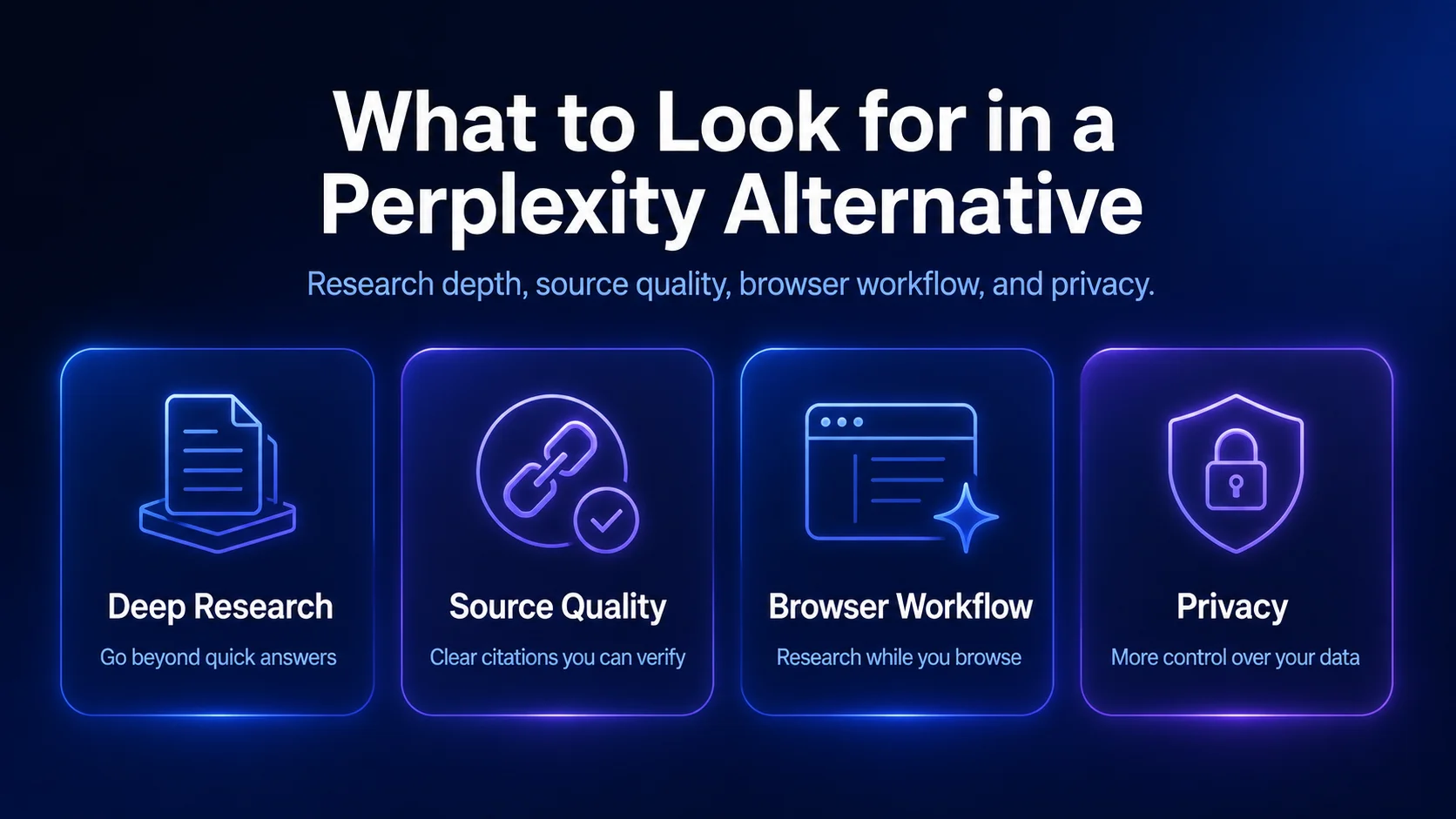
What Makes a Good Perplexity AI Alternative?
A good alternative to Perplexity AI needs more than a chatbot with internet access. At minimum, you want strong web search capabilities, current sources, readable answers, and links you can verify. If an AI tool gives you confident answers without clear sources, that is not research. That is just a very polished guess.
For heavier work, look for deep research, structured data extraction, document analysis, source comparison, and the ability to handle complex research workflows. For academic work, the tool should understand research papers, not just summarize random blog posts. For browsing-heavy work, the best tool may not be a search engine at all. It may be an AI browser that helps you research while you already have sources open.
Search quality matters too. A tool can have real time web search and still give weak answers if it pulls from shallow sources, over-compresses nuance, or cites pages that do not actually support the claim. That is why citation quality is becoming one of the biggest differences between AI search tools in 2026.
How We Chose These Perplexity AI Alternatives
This list focuses on tools that can replace Perplexity AI for at least one real search or research workflow. We looked at AI search quality, web search grounding, research capabilities, source handling, citation usefulness, browser-native research features, and practical fit for specific use cases.
Some tools are better for everyday conversational search. Some are better for deep research. Some are built for academic research, semantic search, or research papers. Others make more sense for privacy first web search, agent research, or AI-assisted browsing.
The goal is not to crown one universal winner. That would be too clean to be honest. The goal is to help you choose the best Perplexity alternative for the way you actually work.
Best Perplexity AI Alternatives Compared
1. Sigma AI Chat / Sigma Browser: Best Perplexity AI Alternative for AI Research While Browsing
Sigma is not a direct Perplexity clone, and that is exactly the point. Perplexity works best as a standalone AI answer engine: you open it, ask a question, and get a cited answer. Sigma fits a different but closely related workflow: AI search and research while you are already browsing.
That makes it useful when research is not one clean question, but a process across tabs, pages, sources, articles, product pages, competitor websites, and documents. Instead of copying links into a separate AI search tool, you can use Sigma AI Chat and Deep Research inside the browser to summarize pages, compare sources, ask follow-up questions, and keep working with the web context in front of you.
This is the main reason Sigma belongs in a Perplexity AI alternatives list. It does not try to replace Perplexity as a classic answer engine. It is a better fit for users who want Perplexity-style research support inside their actual browsing workflow.
For marketers, SEO specialists, writers, analysts, and researchers, Sigma is strongest when the browser itself becomes the research workspace. You can browse, read, check sources, compare information, and use AI assistance without constantly switching between a browser tab and a separate AI tool.
2. ChatGPT Search: Best General Alternative to Perplexity AI
ChatGPT Search is probably the easiest Perplexity AI alternative to recommend for general use. It combines web search, conversational answers, source links, file analysis, writing help, and follow up questions in one place.
The main advantage is flexibility. Perplexity AI is search-first. ChatGPT is assistant-first. That means it can search the web, explain the answer, rewrite it, turn it into a table, compare options, summarize sources, or help you build a plan from the research.
For simple factual searches, Perplexity may still feel cleaner. But once your task goes beyond “find this answer” into “help me do something with this information,” ChatGPT becomes more useful. It is especially strong for broad research questions, content planning, product comparisons, strategy work, and tasks where you want the AI assistant to keep context across follow up questions.
3. Google Gemini: Best Perplexity Alternative for Deep Research and Google Workspace
Google Gemini is one of the strongest alternatives to Perplexity AI if you already work inside Google’s ecosystem. That means Google Search, Google Docs, Gmail, Drive, Sheets, and all the little files you swear you organized but absolutely did not.
Gemini’s biggest advantage is context. It can support deep research, generate longer reports, and connect research tasks with Google Workspace tools. If your research involves your own documents, saved files, emails, or Google Docs, Gemini can feel more practical than Perplexity.
This is where Gemini starts to win: not just open web research, but research connected to your actual work environment. For teams, students, analysts, and marketers, that can be a big deal. The downside is the same as the upside: Gemini lives very deeply inside Google. Some users love that. Some users do not want every research workflow tied to the Google ecosystem.
4. Claude: Best Perplexity Alternative for Deep Reasoning and Careful Analysis
Claude is not always the first tool people mention when they talk about AI search, but it deserves a spot. It is especially good when the question is not just “what happened?” but “what does this actually mean?”
That is Claude’s strength. It handles nuance well. It is good at comparing arguments, explaining trade-offs, summarizing long sources, and turning messy information into something readable without flattening everything into a generic answer.
Perplexity AI is faster and more search-native. Claude feels more like a careful research partner once you already have material to work with. It can help you analyze sources, build a clearer argument, and avoid the weird overconfidence that some AI powered search engines slip into. Claude is not perfect for rapid web search, but it is strong for deep reasoning and source-aware explanations.
5. Brave Search: Best Privacy-First Perplexity AI Alternative
Brave Search is the best option here if you want something that still feels like a real search engine. Not a chatbot. Not a productivity suite. A search engine.
Brave Search combines traditional search results with AI summaries, and its biggest selling point is privacy. It also uses its own independent search index, which makes it different from many AI search tools that rely heavily on another company’s search layer.
That independence matters if you care about the open web. The index decides what the AI can find, rank, and summarize. If every AI tool pulls from the same few sources, search quality gets weirdly narrow.
Brave Search is not as conversational as Perplexity AI. You will not get the same polished answer-engine experience every time. But if your priority is private search, less tracking, and an alternative to traditional search engines, Brave Search is a very solid pick.
6. You.com: Best Perplexity Alternative for Agent Research and Real-Time Web Data
You.com is interesting because it is not only trying to be a consumer AI search tool. It has also moved strongly into real time web data, APIs, AI agents, and search infrastructure.
For everyday users, You.com can work as a conversational search engine. But the more interesting use case is for people who need real time web data, web search grounding, agent research, or structured data workflows.
That makes it different from Perplexity AI. Perplexity is mostly an answer engine. You.com is closer to a search and data layer that can power agents, apps, and research systems. If you are building workflows, tracking web data, doing agent research, or working with structured data extraction, it becomes much more relevant.
7. Elicit: Best Perplexity Alternative for Academic Research
Elicit is not trying to replace Perplexity AI for everything. Good. It should not.
Elicit is built for academic research, especially literature reviews, paper discovery, screening, and extraction. If your sources are research papers, not random web pages, Elicit is much more focused than a general AI search tool.
This is where tools like Perplexity can start to feel too broad. They can summarize research papers, but they are not built around academic workflows. Elicit is. It helps you find papers, compare studies, extract structured information, and work through research questions in a more systematic way.
For academic researchers, students, analysts, and anyone doing evidence-heavy work, this is a better fit than a general answer engine. It is less flashy, maybe. But “less flashy” is sometimes exactly what research needs.
8. Consensus: Best Perplexity Alternative for Evidence-Based Answers
Consensus is another academic research tool, but it has a different job from Elicit. If Elicit is closer to a research assistant for building a literature review, Consensus is closer to a scientific answer engine.
Ask something like “Does creatine improve cognitive performance?” or “Is remote work linked to productivity?” and Consensus focuses on scientific literature instead of the broader web. That makes it useful for health, psychology, education, business, and other topics where you want research papers rather than blog posts.
It is not a replacement for reading the actual studies. No AI tool is. Please do not let a chatbot become your peer reviewer. But Consensus is very useful for first-pass knowledge discovery and evidence checks. Compared with Perplexity AI, Consensus is narrower but more research-focused. That is the trade-off.
9. Kagi Assistant: Best Paid Perplexity Alternative for Private Search
Kagi Assistant is for people who still care about search quality enough to pay for it. Slightly rare. Respectable.
Kagi is a premium search engine with no ads and no tracking. Its assistant adds AI on top of that search experience, so you can use AI when it helps and stick with normal search when you do not want every query turned into a generated answer.
That is the appeal. Kagi does not feel like it is trying to trap you in an AI chat interface. It gives you search, ranking controls, privacy, and optional AI assistance. If Perplexity feels too answer-engine-heavy or too productized, Kagi may feel calmer.
The obvious downside is price. Most people are used to search being “free,” even though free search usually means ads, tracking, and ranking incentives you do not control. Kagi asks for money instead. Weirdly honest, but not for everyone.
Perplexity AI vs Alternatives: Which One Fits Your Use Case?
There is no single best Perplexity alternative for everyone. Some people need faster AI search. Others need deep research, academic sources, privacy, or an AI assistant that works directly inside the browser. Here is the simpler breakdown.
Free vs Paid Perplexity AI Alternatives
Most Perplexity AI alternatives have some kind of free access, but the useful limits vary a lot. ChatGPT Search, Google Gemini, Claude, Brave Search, Elicit, and Consensus can all work as starting points if you want to test alternatives without paying immediately. For heavier research, advanced models, longer context, Deep Research, higher usage limits, or team/API workflows, paid plans become more relevant.
Kagi is the clearest exception because its value is tied to paid private search from the start. You.com also becomes more interesting on paid or API-focused plans if you are building agent research workflows or need real time web data at scale. Sigma is different again: Sigma AI Chat and Deep Research work inside the browser, so the better question is not only “free or paid,” but whether you want AI search and research support inside your browsing environment instead of a separate answer engine.
What People Are Discussing About Perplexity AI in 2026
The most useful conversation around Perplexity AI is not whether it is good or bad. It is whether its original advantage is shrinking.
A few themes keep coming up. Users are comparing Perplexity AI against ChatGPT, Gemini, Grok, Claude, and other AI tools for deeper research and more flexible workflows. Some are frustrated by limits on the free tier or paid plans, especially around file uploads, advanced AI models, and upgrade prompts. Others care about citation quality, because citations are only useful if they actually support the answer.
There is also the publisher debate. Perplexity is part of a broader fight over AI answer engines, publisher content, attribution, traffic, and revenue sharing. Some publishers have sued or challenged AI search companies over content use. Others have signed partnerships with Perplexity, which shows the market is not simply “publishers versus AI.” It is messier than that. Everyone is trying to figure out what search looks like when the answer appears before the click.
And Perplexity itself is moving beyond classic answer search. Its Comet browser and agent direction show that AI search is no longer limited to a separate search page. More tools are moving toward AI inside the browsing workflow, where users can summarize pages, compare sources, handle multi-step tasks, and research without leaving the web context.
That is the traffic angle for 2026: users are not only searching for best Perplexity AI alternatives 2026. They are also searching for tools that do better deep research, better academic research, better source checking, better browsing workflows, better privacy, and better file or document analysis.
Other Alternatives to Perplexity AI Worth Knowing
This article focuses on nine main alternatives, but a few other tools are worth knowing if your use case is more specific.
Grok is relevant if you want real time web data and answers connected to the X ecosystem. It can be useful for fast-moving topics, but it is not as research-focused as Elicit, Consensus, or Gemini Deep Research.
Microsoft Copilot makes sense if your work lives inside Microsoft 365, Edge, Outlook, Teams, and OneDrive. It is less of a pure Perplexity alternative and more of a productivity assistant with web and workplace context.
NotebookLM is useful when your research is built around your own sources. It is not a general search engine, but it can be excellent for summarizing, comparing, and asking questions across uploaded documents.
Exa is more relevant for developers, semantic search, and AI systems that need web search grounding. It is not the most obvious consumer alternative, but it matters in the broader AI search ecosystem.
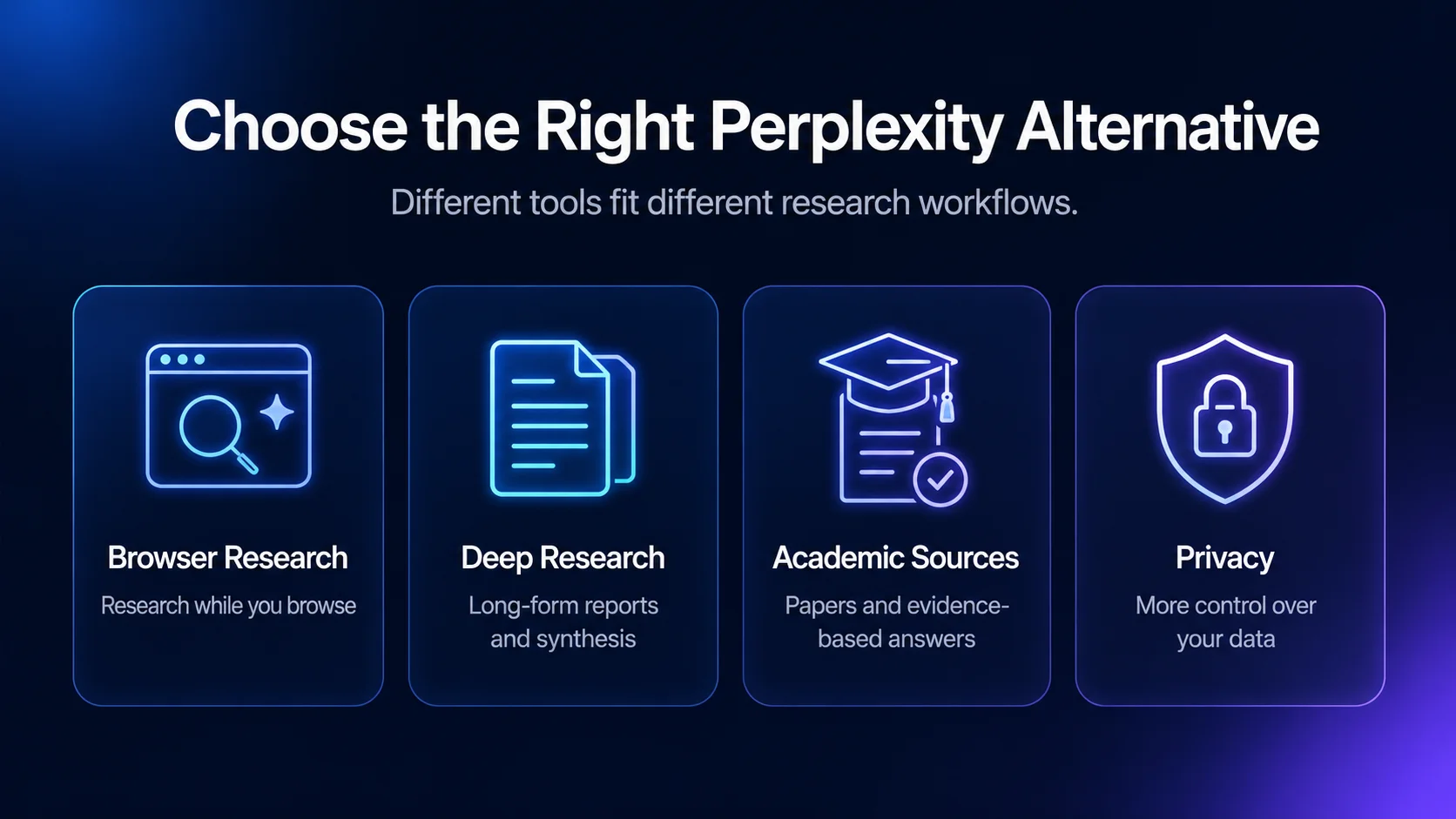
How to Choose the Best Perplexity AI Alternative for Your Workflow
The easiest way to choose is to start with the problem Perplexity does not solve for you.
If Perplexity feels too separate from your browser, choose Sigma AI Chat in Sigma Browser for browser-native AI search, page analysis, and research support. If you want one general AI assistant for search, writing, and analysis, choose ChatGPT Search. If you need deep research reports and Google Workspace integration, choose Google Gemini. If you care about careful synthesis and deep reasoning, choose Claude.
If privacy is your main concern, start with Brave Search or Kagi Assistant. If your research is academic, use Elicit for literature review workflows and Consensus for fast evidence-backed answers. If you are building AI agents or need real time web data and search APIs, You.com is more relevant than it may look at first.
The best AI search tool is not always the one with the most features. It is the one that matches how you actually move through information.
Final Verdict: What Is the Best Perplexity AI Alternative in 2026?
The best Perplexity AI alternative depends on the job.
If you want Perplexity-style research support inside your actual browsing workflow, start with Sigma AI Chat in Sigma Browser. If you want the strongest general AI assistant with web search, use ChatGPT Search. If you live in Google Workspace and need deep research reports, use Google Gemini. If you want careful synthesis and deep reasoning, use Claude. If privacy matters most, test Brave Search or Kagi Assistant. If you work with research papers, skip the general tools and use Elicit or Consensus.
Perplexity AI is still good. That is the honest answer. It remains fast, clean, and useful for conversational search. It is just no longer alone.
In 2026, the best Perplexity alternatives are not all trying to copy Perplexity feature for feature. They are splitting search into better shapes: browser-native research, deep research agents, privacy first search, academic research tools, and AI assistants that can do something useful after the first answer.
And honestly, that is probably healthier for the web.
More articles

Download Sigma Browser
Questions & Answers
reach out to us on X at @Sigma_Browser
Get Sigma on Android


